What is happening in Thailand
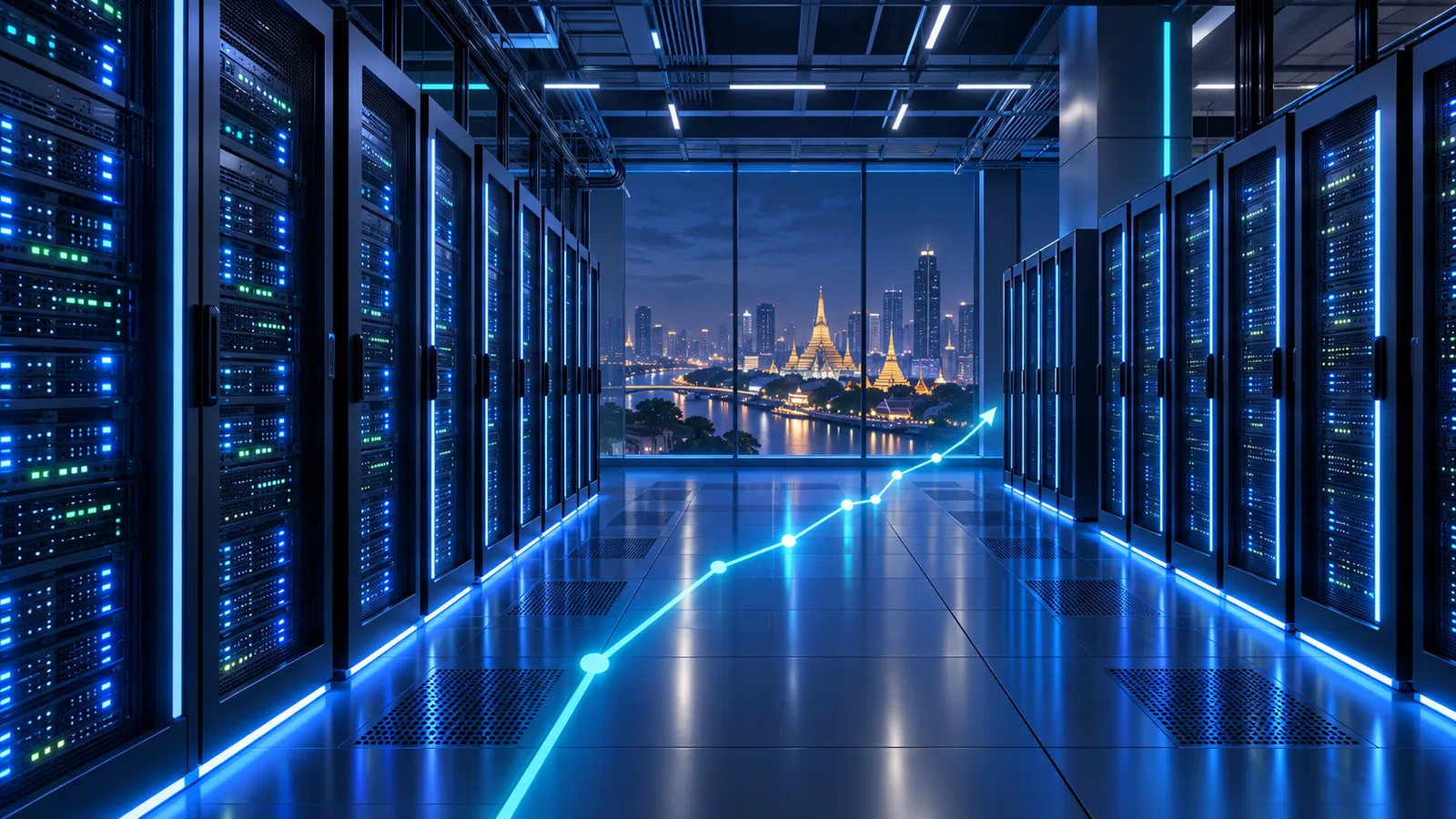
Since 2024, Thailand has become a battleground for the world's largest data center and cloud operators. Google, AWS (Amazon Web Services), Microsoft and ByteDance (TikTok) have all announced plans to build data centers in the country, while regional developers such as Digital Edge — in partnership with B.Grimm Power — closed an US$880 million green loan for a new facility. The core driver is the explosive growth of AI and cloud workloads across the region.
On the government side, Thailand's Board of Investment (BOI) keeps approving data center and cloud service projects at record pace: 42 projects worth about ฿750 billion were approved during 2024–2026, and in the first quarter of 2026 alone another 48 digital-sector applications worth roughly ฿873.7 billion were filed, led by investors from Singapore, the UK and Japan.
The key numbers
| Figure | What it means | Source |
|---|---|---|
| ฿570 billion | Projected data center investment in Thailand, 2026–2030 | Cushman & Wakefield |
| ฿750 billion / 42 projects | BOI-approved projects during 2024–2026 | BOI |
| ฿873.7 billion / 48 projects | Digital-sector BOI applications in Q1 2026 alone | BOI |
| ~฿107 billion/year | Projected annual colocation leasing revenue by 2030 | Cushman & Wakefield |
| 30,000 MW | Potential future electricity demand from data centers and AI | ERC / energy press |
Another striking figure is service density: Thailand currently has about 514,000 people per megawatt of colocation capacity, more than double the Asia-Pacific average of roughly 248,000 people per MW. The market is deeply under-served — which is why pre-leasing of new Thai data center capacity expanded ninefold year-on-year.
Why investors choose Thailand
- Mainland ASEAN's geographic hub — multiple submarine cable landings plus a domestic internet exchange (TH-IX), so traffic no longer has to detour through Singapore.
- A large digital-native market — over 70 million people with world-leading internet and mobile-banking adoption, making low in-country latency commercially valuable.
- BOI incentives — corporate income tax holidays and import duty exemptions on machinery for data center and cloud service businesses.
- Land and construction costs far below Singapore, which has capped new data center builds due to power constraints.
- Yield on cost above 10%, ranking Thailand third in Asia-Pacific for data center investment returns.
New regulations on the way
The boom also strains power and water resources. Thailand's Energy Regulatory Commission (ERC) is preparing a screening framework, expected to take effect around Q4 2026. The main points operators and customers should watch:
- Data center electricity tariffs of roughly ฿5–6 per kWh — above household rates — so large consumers carry their own costs.
- Developers must post grid-capacity guarantees (proposed at about ฿4.5 million per MW) and reach commercial operation within 5–7 years or lose the capacity.
- Large facilities may be required to install their own energy storage systems.
- Water-management plans for cooling are mandatory, so data centers do not compete with households and agriculture.
Impact on Thai businesses
- Lower latency — as workloads move onshore, sites and apps hosted in Thailand respond in single-digit milliseconds for Thai users, versus 30–70ms to Singapore.
- Easier data residency — keeping personal data in-country simplifies PDPA compliance and sector rules from regulators such as the Bank of Thailand and the SEC.
- More choice, better prices — a multi-fold increase in supply puts competitive pressure on local colocation and cloud pricing.
- A stronger ecosystem — cross-connects, CDNs and cloud on-ramps in Thailand will diversify the way Singapore's already have.
- Talent and services growth — data center engineering roles, contractors and managed services are all expanding locally.
How to benefit
- 1Move workloads serving Thai customers back onshore for low latency and PDPA alignment — start with websites, POS/ERP systems and frequently called APIs.
- 2If you own servers, consider colocation instead of an office server room: Tier III power, cooling and networking at a predictable monthly cost.
- 3Choose providers with direct TH-IX and Tier-1 carrier connectivity to ride the expanding ecosystem.
- 4Pilot with something small — a Thai VPS for a new system — and measure latency against your current offshore host.
- 5Plan ahead for AI: models and data that must be processed close to users will benefit most as GPU capacity lands in Thailand.
Triplify Cloud in the boom era
Triplify Cloud delivers VPS, dedicated servers and colocation from a Tier III data center in Bangkok with direct Tier-1 carrier and TH-IX connectivity — so Thai businesses can capture the benefits of this investment wave today, without waiting for a hyperscaler region to launch.
- VPS in Thailand from ฿149/month — millisecond latency for local users.
- Colocation from 1U to full racks in a Tier III facility with N+1 power and 24/7 remote hands.
- 1 Gbps network with unlimited data transfer, peering at TH-IX and Tier-1 carriers.
- PDPA-ready — data stays in Thailand, with 24/7 Thai/English engineering support.
Sources
Figures and news facts in this article were compiled and rewritten from the following public sources (accessed 16 September 2026):
- Nation Thailand — Thailand Set for 570 Billion Baht Data Centre Boom to Fuel AI Surge: nationthailand.com/business/property/40070736
- Eco-Business — Thailand tightens data centre rules as AI boom strains power grid: eco-business.com/news/thailand-tightens-data-centre-rules-as-ai-boom-strains-power-grid
- Thailand Business News — Thailand Approves $29 Billion Investment Wave as Data Center Demand Surges: thailand-business-news.com/investment/328283-thailand-approves-29-billion-investment-wave-as-data-center-demand-surges
- Prachatai — 42 BOI-approved data center projects worth ฿750bn during 2024–2026: prachatai.com/journal/2026/08/118321